

Key Takeaways
- The U.S. shale revolution, driven by hydraulic fracturing and horizontal drilling, turned the United States into the world's largest oil and natural gas producer. Unlike Rockefeller's centralized refining empire, today's boom is decentralized, technology-intensive, and dominated by hundreds of independent producers across basins like the Permian, Eagle Ford, and Marcellus. Hydraulically fractured horizontal wells now account for the vast majority of new U.S. production.
Introduction
Oil has never been just about energy. It has always been about influence. Who controls supply? Who sets the pace? And who benefits when prices move? In the late 19th century, John D. Rockefeller built that influence into something close to absolute power. Through Standard Oil, he shaped the entire industry.
Decisions made at the top affected prices, supply chains, and competitors across the market. It was structured, predictable in its own way, and built for long-term dominance.
Now compare that to the present. The U.S. is once again at the center of a global oil boom, but the landscape has changed completely. The shale revolution rewrote the old playbook. Today, the industry is fast, competitive, and decentralized, chasing efficiency and driven by technology rather than ownership of pipelines or refineries.
The contrast between these two eras says a lot. More than production numbers, it shows how industries evolve when technology begins to outweigh control.
What Is the Shale Revolution?
The shale revolution refers to shale oil investment opportunities driven by the large-scale extraction of oil and natural gas from shale rock formations that were once considered too difficult and expensive to access. These resources were trapped in dense rock, and using conventional methods to extract them simply wasn’t practical.
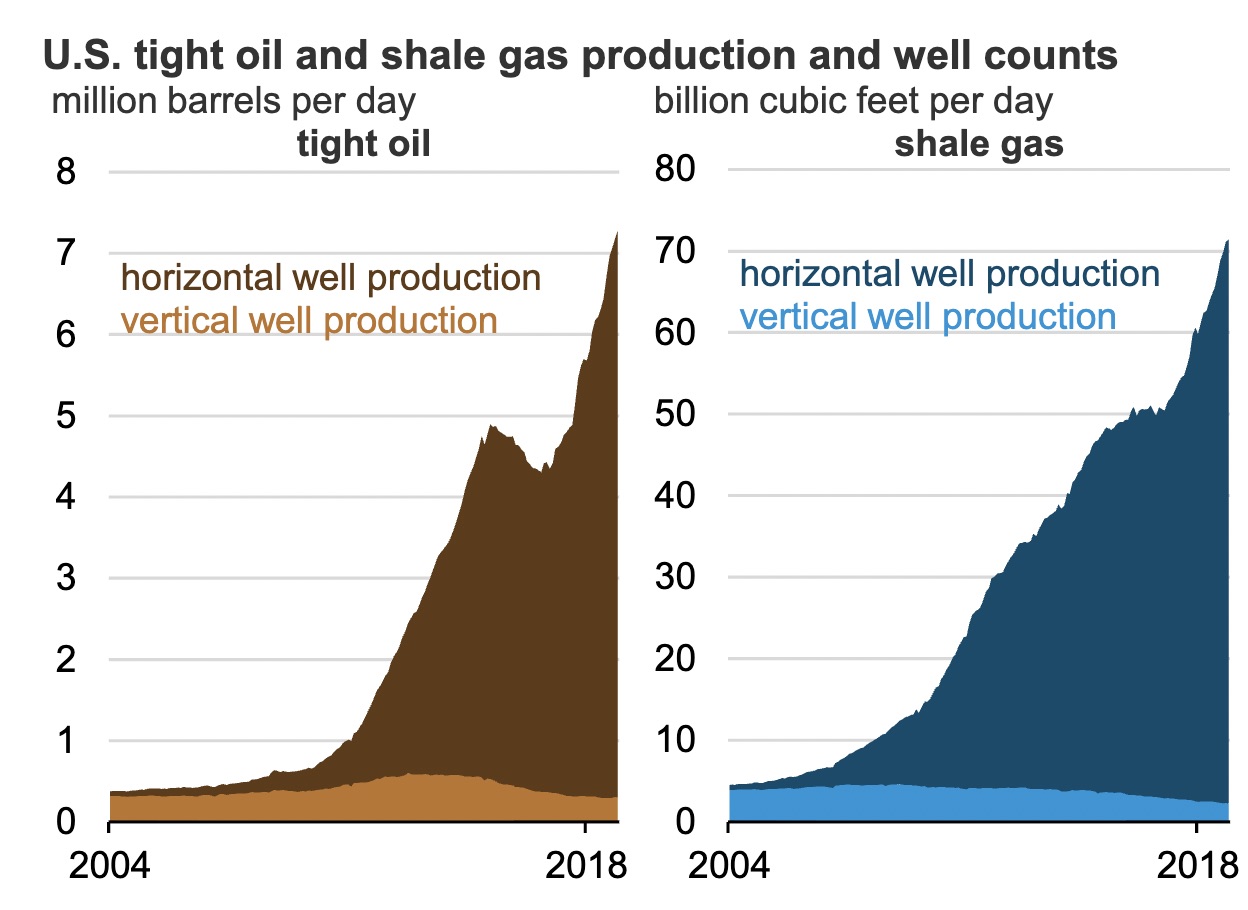
Image source: EIA
Then came two breakthroughs: hydraulic fracturing and horizontal drilling. The commercial viability of this approach was first demonstrated by George Mitchell, whose company spent nearly two decades refining shale gas extraction techniques in the Barnett Shale of Texas. The pivotal breakthrough came in 1997, when one of Mitchell's wells, fractured using a water-based mixture rather than costlier gels, proved financially viable for the first time.
Hydraulic fracturing breaks apart rock formations by injecting fluid at high pressure. Horizontal drilling allows wells to extend sideways through those formations instead of going straight down.
On paper, this sounds like a technical adjustment. In reality, it changed the scale of what could be produced. Fields that were once considered unviable suddenly became productive. By 2018, horizontal wells accounted for 96% of U.S. tight oil and 97% of U.S. shale gas production, according to EIA data. Output rose rapidly, especially in the United States.
What stands out is how quickly this shift happened. Once the methods proved effective, companies were fast to adopt and improve them. That momentum is what turned a technical solution into what is now called the shale revolution.
Rockefeller’s Era vs Today’s Shale Boom
The easiest way to understand the difference between these two periods is to look at how power was built.
Rockefeller's strategy was straightforward, even if executed with precision. He controlled the pipelines, secured favorable transport rates, dominated refining, and gradually eliminated competition. It was not just about producing oil. It was about owning the system through which oil moved. That level of control made standard oil enormously powerful.
The shale boom, by contrast, is defined by decentralization. The market consists of hundreds of public and private exploration and production companies, from large firms to smaller independent operators, with no single dominant trust at the center.
Another clear shift is in what gives a company its edge. In Rockefeller's time, it was scale and infrastructure. Today, it is how effectively a company can drill, manage costs, and adapt to changing conditions. Technology has replaced ownership as the main driver of competitive advantage.
Even the rhythm of the industry feels different. Earlier projects were long-term and relatively stable once established. Shale, on the other hand, moves quickly. Wells can be drilled faster, production ramps up rapidly, and then declines just as fast. It is a system that demands constant activity rather than long-term stability.
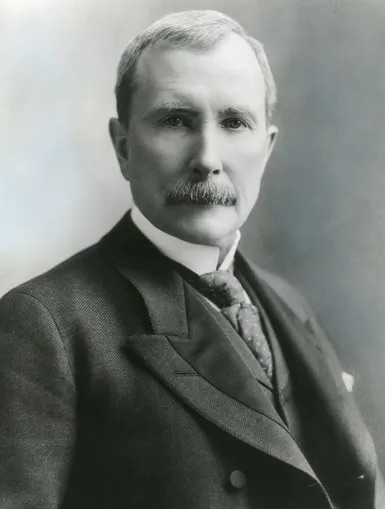
Image source: Britannica
Where Is the Shale Boom Happening?
The shale boom is often discussed as a national trend, but in reality it is shaped by a handful of key regions within the United States.
The Permian Basin in West Texas and New Mexico is the largest U.S. oil-producing basin and continues to attract the most investment. The Eagle Ford Shale in South Texas is a major light oil and condensate producer. The Bakken Formation in North Dakota and Montana pioneered light tight oil extraction at scale, building early confidence in the shale model.
The Marcellus Shale across Pennsylvania, Ohio, and West Virginia dominates U.S. natural gas production, with over 90% of its output coming from horizontal wells. Additional plays like the Niobrara, Haynesville, and Anadarko round out the national picture.
How the U.S. is Leading in Shale
The United States adopted shale technology and was in a position to make it work at scale. A few structural factors made a real difference:
The private ownership of mineral rights gave landowners a direct financial reason to allow drilling.
Strong financial systems made it easier for companies to raise capital and take risks.
A mature oil services sector supported experimentation and rapid improvement.
The existing pipelines and infrastructure helped move production efficiently.
Regulations, while present, allowed companies enough flexibility to expand operations.
None of these factors alone would have been enough. Together, they created a system where new techniques could be tested, improved, and scaled up quickly.
Shale Impact on the Global Energy Picture
The effects of the shale boom have not been limited to the United States. As production grew, the country's role in global energy markets shifted significantly. The U.S. was once heavily dependent on imported oil. It’s a dependency that has since fallen sharply, with the country becoming a major exporter. This has had ripple effects across global markets.
OPEC traditionally held considerable influence over oil supply and pricing, but now operates in a more complex environment where U.S. producers can adjust output relatively quickly. LNG exports also surged after the first large-scale shipments departed in February 2016, reshaping gas markets in Europe and Asia. These shifts also highlight the impact of higher energy prices on global economy, as fluctuations in supply and pricing increasingly influence inflation, trade balances, and industrial costs worldwide.
The overall result is a market that is less predictable but considerably more competitive. Instead of a few players setting the tone, multiple forces are at work, including technological capability, production flexibility, and geopolitical shifts.
What Are the Risks and Limits of the Shale Model?
There are multiple advantages, but despite this, the shale model is not without challenges.
One of the most discussed issues is how quickly wells decline. Typical shale wells lose 50 to 75 per cent of their production in the first year alone. The companies have to keep drilling new wells to maintain overall production levels. This creates a cycle where constant investment is necessary. When oil prices are high, this model works well. When prices drop, it becomes harder to sustain.
The environmental side is equally difficult. Fracking requires tons of water and chemical use, raising concerns about long-term impact. In some areas, there have also been concerns about emissions and minor seismic activity.
The industry also tends to move in boom-and-bust cycles. The phases of growth are often followed by slowdowns, notably in 2015-2016 and again in 2020, depending on market conditions. This instability is part of what makes shale different from older, more stable production systems.
What Would Rockefeller Make of Today's Shale Industry?
If Rockefeller were to look at today’s industry, he would probably find parts of it familiar and parts of it difficult to recognize. The level of competition alone would stand out. The system now has no single player that can dominate the way Standard Oil once did.
At the same time, he might notice signs of consolidation beginning to return. Larger companies are acquiring smaller ones, and there is still value in controlling certain parts of the supply chain, especially infrastructure like pipelines.
But the overall system is harder to control. It moves faster, depends heavily on technology, and spreads activity across multiple regions. Even someone with Rockefeller’s approach would have to adapt to operate within it.
Conclusion
The shale revolution has changed more than production numbers. It has changed how the oil industry functions at a basic level. Rockefeller’s era was built on control, structure, and long-term dominance. The modern shale era is built on adaptability, speed, and competition.
This shift reflects something larger about how industries evolve. Control is no longer the only path to power. In many cases, the ability to innovate and respond quickly matters more.
The story of shale is not only about energy. It is about how economic power evolves, and technology reshapes what is possible, and how power adjusts along with it.
FAQs
What is the shale revolution in simple terms?
It is the method which involves the combination of horizontal drilling and hydraulic fracturing to extract oil and gas from rock formations that were previously difficult to access.
Why does the U.S. lead in shale production?
U.S. leads shale production because of favourable policies, strong financial support, advanced technology, and existing infrastructure.
Is shale production stable?
It is not stable as it requires continuous drilling to maintain output because wells decline quickly.

Comments