

Key Takeaways
- The upstream E&P supply chain is the backbone of oil and gas exploration and production, coordinating everything from seismic surveys to well abandonment. Efficient management of equipment, logistics, and services ensures operations run safely, on schedule, and within budget. Understanding this structured network is essential for operators, engineers, and anyone engaged in oilfield activities to maximize productivity and minimize risk.
Introduction
Exploration and Production (E&P) forms the initial segment of the oil and gas value chain and represents the core of upstream oil and gas operations. It encompasses discovering hydrocarbons, drilling wells, extracting oil and gas, and preparing resources for midstream transport. Because these operations are highly capital- and equipment-intensive, the E&P supply chain plays a pivotal role in ensuring that every stage from geoscience to well abandonment is executed safely, efficiently, and in regulatory compliance.
This guide provides a detailed overview of the upstream supply chain, highlighting each phase, associated equipment, and the critical logistics and services that underpin successful oilfield operations.
Source: Pixabay
The E&P Supply Chain Explained
The upstream E&P supply chain supports all steps required to move a project from early exploration to stable production. It manages technical services, equipment sourcing, field logistics, and compliance tasks that keep operations running smoothly in remote and high-risk environments. Its scope includes:
Sourcing and maintaining drilling rigs: The supply chain secures rigs, drilling tools, casing, and well-control systems, along with essential oilfield equipment and services. It also manages inspections, certifications, and repairs to ensure safe and continuous drilling.
Coordinating seismic and geophysical services: Exploration teams rely on seismic contractors for subsurface imaging. Supply-chain teams handle permits, crew mobilization, survey equipment, and secure transfer of processed data.
Engaging EPC contractors: Field development often requires new surface facilities. The supply chain works with EPC partners to deliver well pads, flowlines, manifolds, early-production units, and related infrastructure.
Managing logistics for personnel and materials: Upstream operations often take place offshore or in remote regions. The supply chain arranges transport, drilling consumables, chemicals, heavy equipment, and regulated movement of hazardous materials.
Supporting maintenance and environmental compliance: Production sites need regular maintenance, spare parts, inspection services, and monitoring systems. The supply chain ensures compliance with safety and environmental standards.
Unlike midstream or downstream, the upstream sector focuses on discovering and producing hydrocarbons, making its supply chain highly specialized and equipment-intensive.
Core Phases of Exploration and Production
Search & Exploration
Exploration is the first step in upstream oil and gas operations, focused on identifying potential hydrocarbon reservoirs. It combines scientific, technical, and regulatory activities to locate and evaluate economically viable resources.
Key Activities:
Geological and geophysical surveys: Experts study rock formations, surface features, and subsurface structures to identify potential reservoirs. This involves mapping, sampling, and analyzing geological data to guide exploration drilling decisions.
Seismic data acquisition and processing: Seismic surveys use controlled energy sources to create subsurface images. Data is processed and interpreted to locate hydrocarbon traps and assess reservoir size and structure.
Reservoir modeling and resource estimation: Engineers and geoscientists build models to simulate reservoir behavior. These models estimate volumes of oil and gas, predict production rates, and support investment decisions.
Licensing, permitting, and land access: Companies obtain rights to explore and drill through government and private agreements.
Environmental and regulatory assessments: Environmental studies identify potential impacts on ecosystems and communities. Compliance with regulations ensures sustainable exploration and mitigates environmental risks.
Supply Chain Needs:
Seismic acquisition equipment (vibroseis trucks, marine air guns)
Survey crews and geoscience service providers
Permitting support and legal services
Data management and geospatial analysis tools
This stage determines whether drilling is commercially and geologically viable. Efficient coordination ensures timely identification of promising sites and reduces exploration risk.
Well Construction
After exploration confirms hydrocarbons, drilling operations begin. Well construction turns geological data into a safe, productive well, following strict engineering and safety standards.
Key Activities:
Mobilizing drilling rigs and support units: Transport and set up rigs and field crews. Ensure safety compliance and readiness for drilling.
Purchasing casing, tubing, drill bits, mud, and cement: Procure essential materials for well stability, fluid management, and efficient drilling.
Engineering design for well architecture: Plan well path, casing, and completion strategy for safety and optimal production.
Directional or horizontal drilling: Reach target reservoirs precisely and maximize hydrocarbon recovery.
Well testing and evaluation: Measure pressure, flow rates, and reservoir properties to guide production planning.
Supply Chain Needs:
Drilling contractors and oilfield service companies
Rig mobilization and logistics management
Safety, well-control, and monitoring equipment
Continuous delivery of consumables (mud, cement, chemicals)
Drilling is capital-intensive, so precise scheduling and equipment delivery are essential to maintain project timelines and minimize cost overruns.
Extraction and Production
After well completion, hydrocarbons are brought to the surface and prepared for transport. This phase ensures efficient production, product quality, and compliance with safety and environmental standards. Continuous monitoring and management help maximize recovery and maintain stable operations.
Key Activities:
Installing artificial lift systems (pumps, gas lifts)
Artificial lifts move oil and gas to the surface when natural pressure is low. Systems include rod pumps, ESPs, and gas lifts.
Separating oil, gas, and water; dehydrating fluids
Separators divide oil, gas, and water, while dehydration removes moisture from gas. This protects equipment, improves quality, and ensures hydrocarbons meet pipeline or processing specs.
Flow rate monitoring and optimization
Continuous measurement of pressure, temperature, and volume maintains production efficiency.
Temporary storage and handling
Oil and gas are stored in tanks or vessels before midstream transfer. Storage maintains quality, prevents spills, and follows safety regulations.
Transportation to midstream facilities
Hydrocarbons are moved via pipelines, trucks, or tankers to midstream operators. Coordination and compliance ensure smooth, safe handoff.
Supply Chain Needs:
Pumps, separators, flowlines, and storage tanks
Production chemicals for flow assurance
Pipeline or trucking coordination
Spare parts, maintenance, and repair services
Effective production supply chains maximize output, prevent downtime, and maintain safe and efficient operations.
Well Abandonment
Wells reach the end of their economic life or become nonproductive. Responsible closure is critical for environmental protection, safety, and regulatory compliance.
Key Activities:
Plugging the wellbore with cement: Cement plugs are placed to seal the well and prevent fluid migration. This ensures long-term containment of hydrocarbons and protects groundwater.
Removing surface equipment and infrastructure: All rigs, pumps, pipelines, and other installations are dismantled. Materials are often recycled or disposed of according to safety and environmental standards.
Site restoration and rehabilitation: The land or offshore site is returned to its natural condition or agreed-upon use. Vegetation is restored, and erosion or contamination is mitigated.
Regulatory documentation and reporting: Detailed reports confirm that abandonment procedures meet legal and safety requirements. These documents are submitted to authorities for compliance verification.
Supply Chain Needs:
Abandonment plugs and cementing units
Environmental restoration contractors
Surveying, inspection, and compliance services
Well abandonment ensures long-term environmental protection and adherence to regulatory standards.
Integration With Midstream and Downstream Operations
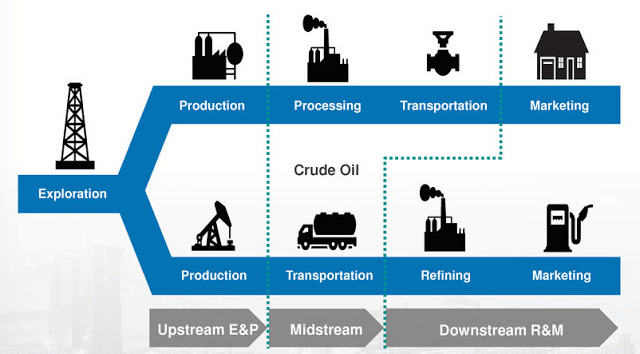
Although Exploration & Production (E&P) sits in the upstream segment, understanding upstream vs downstream oil and gas operations is essential because these sectors must work in constant coordination. According to sources like the Energy Information Administration (EIA), delays or inefficiencies in one segment directly affect performance across the entire industry.
Midstream Integration
Midstream companies handle the movement and temporary storage of produced hydrocarbons. Their systems depend heavily on timely and consistent output from E&P operations. Key midstream functions include:
Pipelines, gathering systems, storage tanks, and tankers
Midstream networks collect crude oil and natural gas at the wellhead and move them to processing points or export terminals. Reliable upstream production ensures these systems operate at planned capacity.
Initial crude and gas processing and transportation
Midstream facilities often perform basic processing such as gas dehydration, natural gas liquids (NGL) separation, and crude stabilization before further transport. Upstream providers must supply volumes that meet midstream technical specifications to avoid flow disruptions.
Downstream Integration
Downstream operations turn raw hydrocarbons into market-ready products. According to Investopedia, this segment includes refining, petrochemical production, and fuel distribution. It relies on midstream transport and ultimately on steady upstream output. Key downstream functions include:
Refineries and gas plants producing fuels and petrochemicals
Refineries require predictable crude blends and steady supply rates. Variability in upstream production can impact refinery throughput and efficiency.
Distribution to retailers and end-users
Finished products such as gasoline, diesel, jet fuel, LPG, and lubricants move from refineries to wholesalers, retailers, and consumers. Stable upstream production supports consistent supply in domestic and global markets.
A strong and well-managed upstream supply chain ensures a smooth handoff across the broader oil and gas value chain, reducing bottlenecks in storage capacity, refinery scheduling, export flows, and ultimately fuel availability when coordination breaks down.
Credit Reference: Proposing a conceptual model for cloud computing adoption in upstream oil & gas sector - Scientific Figure on ResearchGate. Available from: https://www.researchgate.net/figure/Oil-and-gas-industry-value-chain_fig2_347071846 [accessed 5 Dec 2025]
Why an Efficient E&P Supply Chain Matters
An optimized supply chain:
Minimizes downtime and operational delays
Reduces operational and procurement costs
Enhances drilling and production efficiency
Improves safety and regulatory compliance
Supports better project planning, forecasting, and decision-making
Given the uncertainty in exploration and production, a well-managed supply chain allows operators to maintain control, predictability, and resilience.
FAQs
What is the E&P supply chain in oil and gas?
The E&P (Exploration & Production) supply chain covers all upstream activities that turn geological potential into commercial hydrocarbons. It includes exploration, seismic surveys, drilling, well completion, production, and eventual well abandonment. Supporting functions such as equipment procurement, logistics, maintenance, and environmental compliance are integral. A well-managed supply chain ensures that operations run efficiently, safely, and in compliance with regulatory requirements, even in remote or challenging environments where upstream activities are carried out.
Why is supply chain management important in upstream operations?
Effective supply chain management in upstream operations is crucial because it ensures timely delivery of rigs, tools, consumables, and personnel. It minimizes operational downtime, reduces costs, and enhances safety by ensuring equipment and materials meet standards. Additionally, it supports regulatory compliance and environmental safeguards.
What types of equipment are critical in the E&P supply chain?
The E&P supply chain relies on specialized equipment to carry out exploration and production safely and efficiently. Key items include drilling rigs (land and offshore), downhole tools, casing and tubing, well-control systems, mud and cementing equipment, pumps, separators, and production chemicals. Seismic acquisition tools and monitoring instruments are essential during exploration. Regular maintenance and certification of this equipment are critical to prevent failures, ensure compliance with safety regulations, and maintain continuous operations throughout the lifecycle of a well.
How does E&P connect to midstream and downstream operations?
Upstream (E&P) operations produce crude oil or natural gas, which must be transported to refineries or processing facilities. Midstream infrastructure, such as pipelines, storage tanks, and tankers, moves these hydrocarbons from production sites to downstream plants. Downstream operations then refine or process the oil and gas into fuels, petrochemicals, and other products for distribution to retailers and end-users. A robust upstream supply chain ensures consistent production and smooth handoff, preventing bottlenecks and supporting the overall efficiency of the oil and gas value chain.
What happens during abandonment?
Well abandonment, also called decommissioning, occurs when a well is no longer productive or viable. The process involves safely plugging the well with cement, removing surface and subsurface equipment, and restoring the site to minimize environmental impact. Documentation and regulatory compliance are essential to prevent future leaks or hazards. Well abandonment is a critical part of the upstream lifecycle, ensuring that oil and gas operations do not leave lasting environmental or safety risks, and that land or offshore areas can be returned to safe use.
Conclusion
A strong and well-coordinated upstream supply chain is essential for the success of E&P operations. It not only supports exploration and production but also ensures seamless integration with midstream and downstream processes. Efficient supply chain management reduces costs, minimizes risks, and promotes safety and environmental responsibility across the oil and gas value chain.
Want to stay updated on the latest trends in energy and oil & gas operations? Subscribe to Invest In Energy’s newsletter for up-to-date insights, expert analysis, and practical industry updates.

Comments