

Key Takeaways
- The EIA's 250-year review shows that U.S. energy consumption continues to evolve, but fossil fuels remain the foundation of the country's energy system. For investors, the report underscores that energy transitions typically unfold over decades, creating opportunities across both traditional energy industries and emerging electricity and renewable infrastructure.
A new historical review from the U.S. Energy Information Administration (EIA) traces how energy consumption has evolved over the past 250 years, highlighting the shift from wood and coal to petroleum, natural gas, nuclear power, and renewable energy. While the country's energy mix has become increasingly diversified, fossil fuels remain the primary source of energy consumption, illustrating both the pace of technological change and the continued importance of hydrocarbons in the modern economy.
According to the EIA, total U.S. energy consumption reached approximately 96 quadrillion British thermal units (quads) in 2025, representing a 2% increase from the previous year. Although this remains below the record level recorded in 2007, petroleum and natural gas continued to account for the largest share of energy demand. Renewable energy, coal, and nuclear power each contributed roughly 9% of total consumption.
Energy Sources Have Shifted Alongside Economic Development
During the country's early history, wood served as the primary energy source for heating, cooking, and lighting. As industrialization accelerated during the nineteenth century, coal became increasingly important, supporting railroad expansion, manufacturing, and electricity generation.
The twentieth century marked another major transition. Petroleum emerged as the dominant fuel as automobiles, aviation, and commercial transportation expanded. Natural gas also became more widely used after pipeline infrastructure improved, allowing it to serve residential, commercial, and industrial markets more efficiently.
Electricity demand continued to rise throughout the century, supported by economic growth, widespread electrification, and the development of household appliances, computing, and industrial equipment. Nuclear power entered the energy mix during the late 1950s, providing another large-scale source of electricity generation.
Today, the U.S. energy system reflects a much broader mix of fuels, with hydrocarbons, nuclear energy, and renewable technologies all contributing to overall supply.
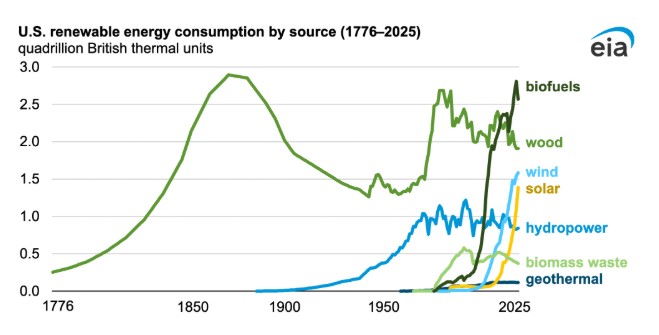
Data source: U.S. Energy Information Administration, Monthly Energy Review
Data Values: Renewable Energy Production and Consumption by Source and Estimated primary energy consumption in the United States, selected years, 1635–1945
Table 1. Evolution of Major U.S. Energy Sources
Time Period | Primary Energy Trend | Key Development |
1776–1800s | Wood dominated | Heating, cooking, and lighting |
Mid-1800s | Coal expanded | Railroads and industrialization increased demand |
Early 1900s | Petroleum growth | Automobiles, aviation, and refining transformed transportation |
Mid-1900s | Natural gas and nuclear emerged | Pipeline expansion and commercial nuclear generation |
2000–2025 | Renewables grew alongside natural gas | Wind, solar, and shale gas reshaped electricity generation |
Renewable Energy Continues to Expand
One of the most notable long-term trends highlighted by the EIA is the steady growth of renewable energy.
Renewables surpassed nuclear energy consumption in 2022 for the first time since the mid-1980s. A year later, renewable energy consumption exceeded coal, marking another significant milestone in the country's changing energy landscape.
Within renewable energy, wind and solar have experienced rapid growth and now contribute more energy than hydropower. Biofuels have also become the largest renewable fuel source, supported by increased production of ethanol, biodiesel, and renewable diesel.
Despite these gains, fossil fuels still represented approximately 82% of total U.S. energy consumption in 2025, demonstrating that conventional energy sources continue to play a central role in meeting overall demand.
Electricity Demand Is Creating New Sources of Energy Growth
The report also points to emerging drivers of electricity demand that are influencing future energy consumption.
Growing use of data centers, digital technologies, cryptocurrency mining, and electric vehicles has increased electricity requirements. The EIA expects electricity demand to grow at one of its fastest rates in decades through the remainder of the decade, driven largely by expanding computing infrastructure.
Electric vehicle adoption is also contributing to higher electricity consumption. Nearly six million electric vehicles were operating on U.S. roads in 2024, with electricity consumption from light-duty EVs increasing substantially over recent years.
These trends suggest that future energy demand may increasingly depend on reliable electricity generation rather than simply replacing one fuel source with another.
Table 2. Key Energy Consumption Highlights (2025)
Metric | 2025 Result |
Total U.S. energy consumption | 96 quadrillion BTUs |
Change from previous year | +2% |
Largest energy source | Petroleum |
Second-largest energy source | Natural gas |
Fossil fuel share of total consumption | 82% |
Share of renewables, coal, and nuclear | About 9% each |
Fast-growing electricity demand drivers | Data centers, electric vehicles, digital infrastructure |
Why the Report Matters for Energy Investors
Historical energy consumption trends provide important context for investors evaluating long-term opportunities across the energy sector.
Rather than showing a rapid replacement of traditional fuels, the data demonstrates that new energy technologies are generally added alongside existing energy sources. Petroleum and natural gas continue to support transportation, manufacturing, industrial production, and electricity generation even as renewable capacity expands.
For investors, this reinforces the importance of viewing the energy sector as a diversified market. Traditional oil and gas companies, pipeline operators, electric utilities, renewable developers, and infrastructure providers all participate in meeting growing energy demand.
The report also highlights that rising electricity consumption may create investment opportunities across multiple industries, including natural gas generation, transmission infrastructure, renewable energy, battery storage, and grid modernization. Understanding these long-term consumption patterns can help investors better evaluate structural trends rather than focusing solely on short-term commodity price movements.
Readers can read the original news on the U.S. Energy Information Administration (EIA) website through this link: The 250-year history of U.S. energy consumption.
