
Key Takeaways
- Retail gasoline prices, crude oil benchmarks, and energy stock performance are connected but rarely move in lockstep. Refining margins, taxes, hedging, and company-level factors create gaps between the three. Investors who track crude and pump prices as if they're interchangeable with stock performance risk misreading what's actually driving returns.
Introduction
Crude oil, the price at the pump, and energy stocks all trace back to the same commodity, which is why investors often treat them as a single signal moving in one direction. In practice, the three connect through different mechanisms, refining, taxes, company balance sheets, and each can move at its own pace even when the others stay flat. The gap between them, not just the direction they share, is what actually shapes energy sector returns.
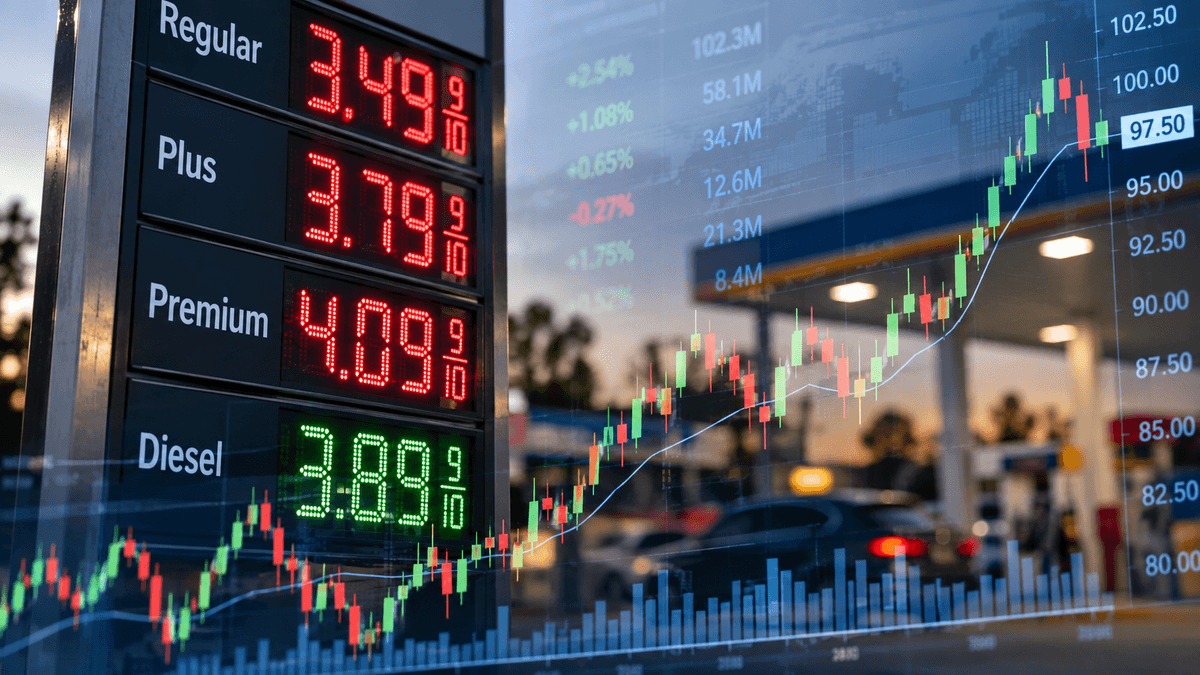
The current stretch of data shows that gap clearly. According to AAA's daily fuel tracker, the national average price for regular gasoline reached $4.28 a gallon on September 10, 2026 from $2.83 in mid-January. Over the same stretch, WTI crude climbed from the mid-$40s to the low $90s, more than doubling. According to Investing.com's sector performance tracker, over that same period, the Energy Select Sector SPDR Fund (XLE), the largest energy-focused ETF, gained 42.32% year-to-date through late August, nearly triple its closest S&P 500 sector rival. Three connected markets, three different percentage moves, and the rest of this article breaks down why.
Why Retail Gas Prices Lag Crude Oil
Crude oil is the largest input into a gallon of gasoline. An article from The Conversation validates the US Energy Information Administration process that the price of a retail gallon of gas is the sum of four things: the cost of crude oil, refining, distribution and marketing, and taxes.
Cost Component | Typical Share of Retail Price |
Crude oil | 50%–60% |
Refining margin | 15%–25% (higher during supply disruptions) |
Distribution & marketing | 10%–15% |
Federal & state taxes | 10%–15% |
Source: US Energy Information Administration, Gasoline and Diesel Fuel Update.
Taxes and distribution costs stay fairly fixed regardless of what crude does. Refining margins, by comparison, expand and contract based on how tight the market is for finished products like gasoline and diesel, separately from crude supply itself. That's why gasoline can rise even when crude holds steady, or lag behind a crude spike by several weeks.
The Crack Spread: The Metric Behind the Gap
The refining margin has a name in energy markets: the crack spread. The standard version, the 3-2-1 crack spread, estimates the profit from turning three barrels of crude into two barrels of gasoline and one barrel of distillate fuel.
Between 2010 and 2021, this spread averaged $10 to $16 per barrel, according to industry benchmarks tracked by Britannica Money's explainer on refining margins. In 2026, spreads have run well above that range for extended stretches, at times behaving as if crude were priced $15 to $20 higher than benchmark futures actually showed, tied to refinery outages and tight product supply in several regions. Wider crack spreads mean refiners keep a larger share of the difference between crude cost and pump price, a dynamic that shapes company profits independently of the crude price itself.
Why Energy Stocks Move at a Different Speed Too
Energy stocks add a second layer of separation from crude prices. XLE's 42% year-to-date gain outpaced both the rise in crude and the rise in retail gasoline, a gap that comes down to a few company-level factors:
Factor | Effect on Stock Performance |
Hedging programs | Can smooth out or delay how much of a crude price move reaches earnings |
Refining exposure | Companies with refining assets benefit directly from wide crack spreads, on top of crude gains |
Buybacks & dividends | Higher cash flow supports shareholder returns beyond what crude price alone would suggest |
Valuation re-rating | Cheap starting valuations (XLE traded near a 13x P/E in mid-2026) leave more room for share prices to expand |
Balance sheet strength | Lower debt levels reduce risk premiums investors apply to a stock, supporting higher multiples |
XLE valuation and return data from Investing.com, current as of late August 2026.
Integrated majors and refiners with strong balance sheets have often captured more of this upside than smaller producers carrying heavier debt loads, since equity markets price in both the commodity move and the company's ability to convert that move into free cash flow.
What This Means for Energy Investors
A few practical takeaways follow from this gap:
Pump prices are a consumer indicator, not a stock signal. A jump at the gas station reflects crude, refining tightness, and taxes together, not what a specific energy stock will do next.
Refiners and integrated majors often benefit twice during periods of wide crack spreads, first from crude price gains, then from refining margin expansion.
Company-specific factors, hedging, debt, buyback pace, matter more than headline crude prices for predicting near-term equity returns.
A rising XLE doesn't always mean rising costs for consumers, and falling pump prices don't always signal falling energy stock values, since valuation and cash flow dynamics move on their own timeline.
Investors need to educate themselves from a strategies and valuation guide covering how these company-level factors are typically weighed alongside commodity price trends.
Conclusion
Crude oil, pump prices, and energy stocks are connected through the same underlying market, but each responds to a different set of pressures and on a different timeline. Refining margins, taxes, hedging, and valuation all sit between the crude price an investor sees in a headline and the return that actually shows up in an energy stock or fund. Reading these as separate, related signals, rather than one number standing in for all three, gives investors a clearer picture of what's actually driving performance.
Readers can follow current fuel price data through AAA's Gas Prices tracker and sector performance through Investing.com's markets coverage.
