
Key Takeaways
- Utility-scale solar is the fastest-growing segment in U.S. electricity generation, supported by battery storage and regional expansions in Texas and other states. Natural gas remains the largest source but continues to lose share, while coal declines steadily, signaling ongoing investment opportunities in renewable and flexible power assets.
The U.S. electricity sector is set for steady growth over the next two years, driven primarily by utility-scale solar, according to the Energy Information Administration’s (EIA) latest Short-Term Energy Outlook (STEO). Total electricity generation is projected to rise from 4,260 billion kilowatt-hours (BkWh) in 2025 to 4,423 BkWh by 2027, a 3.9% increase.
Traditional dispatchable sources—natural gas, coal, and nuclear—accounted for 75% of total generation in 2025, but their combined share is forecast to decline to 72% by 2027. At the same time, the combined share of solar and wind generation is expected to rise from 18% in 2025 to 21% in 2027, reflecting ongoing renewable capacity additions and policy support.
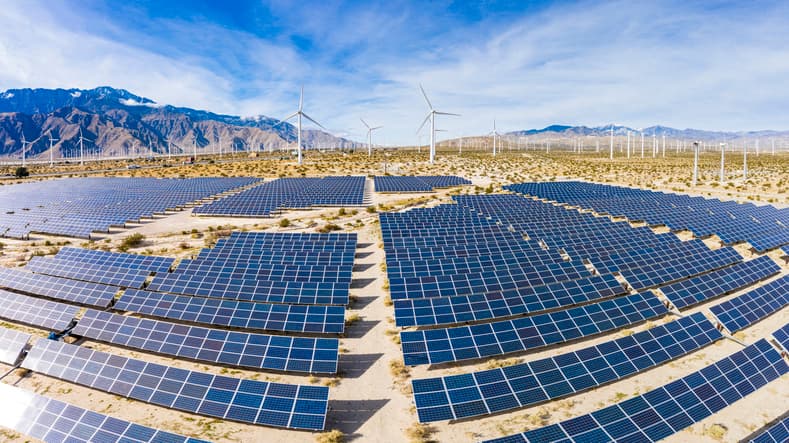
Solar generation is the fastest-growing segment, increasing from 290 BkWh in 2025 to 424 BkWh by 2027. The growth is supported by nearly 70 gigawatts (GW) of new solar capacity coming online over the period, representing a 49% increase in U.S. solar operating capacity. Texas is a key driver, with solar generation in the ERCOT grid forecast to grow from 56 BkWh to 106 BkWh, supported by expanding battery storage capacity from 15 GW to 37 GW to smooth daily output fluctuations.
Natural gas remains the largest source of U.S. electricity but is losing share. Gas-fired generation is projected to remain around 1,696 BkWh in 2026, rising modestly to 1,711 BkWh in 2027, while total generation grows faster, reducing its share to 39%. Growth is strongest in ERCOT and PJM, driven in part by increasing electricity demand from data centers.
Coal-fired generation, which rose temporarily in 2025 due to cold weather and higher gas prices, is expected to decline as plant retirements progress, falling 5% annually to 661 BkWh in 2027, reducing its share to 15%. Wind generation is mostly stable, particularly in the MISO region, averaging just over 100 BkWh annually, though new solar capacity in MISO is expected to grow from 31 BkWh to 46 BkWh.
The forecast highlights the ongoing transition in the U.S. power mix, with renewables, especially solar, playing an increasingly central role. Investors in electricity infrastructure, grid modernization, and energy storage may find opportunities as demand grows and the generation mix shifts.
Reference:
U.S. Energy Information Administration – In-brief analysis
Solar power generation drives electricity generation growth over the next two years
