

Key Takeaways
- Midstream infrastructure includes pipelines, storage tanks, processing plants, and export terminals. These are the physical network that moves hydrocarbons from wells to refineries and customers. Companies that own these assets earn fee-based cash flow that is largely insulated from commodity prices. This mirrors Rockefeller's original strategy of controlling rail and pipeline transport to dominate the oil chain. Today, firms like Enterprise Products Partners, Energy Transfer, Kinder Morgan, and Williams Companies hold similar structural advantages.
What Is Midstream Infrastructure?
Midstream is the connective tissue of the oil and gas industry, and without it, upstream production has nowhere to go. This is why top midstream oil and gas stocks continue to attract strong investor attention.
The energy industry is typically divided into three segments: upstream, midstream, and downstream.
Upstream refers to the exploration, development, and production of oil and gas at the wellhead.
Downstream covers refining, processing, and the sale of finished products to consumers.
Midstream sits between them, performing the unglamorous but indispensable work of moving hydrocarbons from where they are found to where they are needed.
The core asset categories in midstream are:
Gathering systems: These small-diameter pipelines collect raw oil and gas directly from the wellhead and transport them to processing facilities.
Transmission: Long-haul pipelines that transport crude oil, natural gas, and natural gas liquids (NGLs) over long distances, often across states or countries.
Storage terminals: These help manage supply volatility during times of low demand by allowing companies to store crude or products, such as in salt caverns and tank farms, for later use.
Gas processing plants: Processing plants strip impurities and separate natural gas liquids (NGLs).
Fractionators: These break down NGL mixtures into individual products like ethane, propane, butane, and natural gasoline.
LNG export facilities: These are increasingly important midstream assets that liquefy natural gas for shipment to overseas markets.
Real-world landmarks illustrate the scale of this infrastructure. The Colonial Pipeline is the largest refined fuel pipeline in the United States, stretching roughly 5,500 miles from Houston to New York Harbor and carrying gasoline, diesel, and jet fuel that powers the Eastern Seaboard.
Sabine Pass LNG, operated by Cheniere Energy in Louisiana, was the first major U.S. LNG export terminal to come online and helped transform America into a leading global gas exporter. Cushing, Oklahoma, is the designated delivery hub for West Texas Intermediate (WTI) crude futures and serves as the pricing point for much of U.S. oil production.
The commercial structure of midstream is what makes it attractive to long-term investors. Most revenue comes from long-term, fee-based contracts rather than direct exposure to commodity prices. Whether oil trades at $50 or $100 a barrel, a pipeline operator collecting a fixed toll per barrel moved earns roughly the same amount. This model turns physical geography into a financial asset.
How Did Rockefeller Use Transportation as a Moat?

Image Source: Britannica
John D. Rockefeller built Standard Oil into the dominant force in American energy through relentless control of transportation infrastructure. In the 1870s, railroads were the only way to move crude oil from the Pennsylvania oil fields to Eastern refineries. Rockefeller negotiated secret rebates with the major railroads, often paying half the published rate that competitors faced. In some agreements, Standard Oil also received drawbacks, a portion of what rivals paid, effectively subsidizing its own operations with its competitors' freight costs. Rockefeller's biggest single advantage was rail rebates and, eventually, his own pipelines.
When railroads proved too politically sensitive and too dependent on third-party relationships, Rockefeller built his own long-distance crude pipelines. Owning the path meant Standard Oil could refine more cheaply than anyone else and price its products below what smaller rivals could afford to match. Competitors who could not access transport at a comparable cost were either absorbed or driven out.
The logistics moat was, in many ways, more powerful than any other advantage Standard Oil possessed. Public outrage during the antitrust era focused as much on the railroad rebates and pipeline control as it did on Standard Oil's refining dominance. Ida Tarbell's landmark investigative work devoted extensive attention to transportation practices precisely because they were the mechanism through which Standard Oil exercised market control. The logic was that whoever controls the path controls the price.
Who Owns U.S. Midstream Today?
A handful of large, publicly traded firms own the bulk of U.S. midstream capacity. And the sector is consolidating fast.
The modern midstream landscape is dominated by a concentrated group of publicly traded companies, most of which have grown through aggressive acquisition as well as organic expansion.
Enterprise Products Partners remains one of the largest MLPs in North America, with a market capitalization above $74 billion as of early 2026. The company operates more than 50,000 miles of pipelines transporting NGLs, crude oil, natural gas, petrochemicals, and refined products. It also owns storage, processing, manufacturing, and export facilities. Enterprise delivered its 27th consecutive year of distribution increases in 2025 and currently has approximately $4.8 billion in major capital projects under construction, expected to enter service by the end of 2027. The company holds the highest credit rating in the midstream space.
Energy Transfer is one of the most diversified midstream operators in the U.S., with extensive natural gas, NGL, and crude oil pipeline networks spanning multiple production basins and market hubs. Its market cap sits near $62 billion, and it operates one of the broadest multi-commodity networks in the country.
Kinder Morgan operates roughly 83,000 miles of pipelines and extensive terminal assets across North America, making it one of the largest energy infrastructure networks on the continent. The company focuses heavily on natural gas transport, generating steady, fee-based earnings across a system that serves nearly every major U.S. market region.
Williams Companies dominates natural gas infrastructure in the Marcellus and Northeast, operating the Transco pipeline. This is the largest-volume natural gas transmission system in North America. Williams has been expanding its deepwater gathering and Gulf Coast exposure as domestic gas demand, particularly for LNG export, accelerates.
ONEOK has undergone a dramatic transformation in recent years through aggressive consolidation. After acquiring Magellan Midstream Partners in 2023, ONEOK completed its $4.3 billion all-stock acquisition of EnLink Midstream in January 2025, absorbing its natural gas, NGL, crude, and CO2 transportation assets into a 60,000-mile pipeline network. The deal added major positions in the Permian Basin, Louisiana, Oklahoma, and North Texas. ONEOK also took full control of Delaware G&P LLC for nearly $1 billion in 2025. The company reported adjusted EBITDA of $8.02 billion for 2025, an 18% increase over 2024 levels. ONEOK's buying spree reflects a broader sector thesis: that scale, geographic reach, and multi-commodity capability are becoming essential to compete for the next wave of infrastructure spending.
Targa Resources has emerged as another fast-growing player, with a market cap approaching $43 billion and a strong presence in Permian Basin gathering and processing. MPLX, the midstream affiliate of Marathon Petroleum, operates crude oil logistics and natural gas processing assets and has consistently grown distributions since its 2012 formation.
Plains All American Pipeline remains a significant crude oil pipeline operator, while integrated majors, including ExxonMobil and Chevron, hold substantial midstream assets internally, often embedded within their broader corporate structures.
The overarching trend, however, is consolidation. Smaller operators are being absorbed into platforms large enough to finance multi-billion-dollar infrastructure corridors, connect new LNG export terminals, and meet the capital demands of an accelerating energy export cycle. The midstream sector's average fee-based revenue share stands at approximately 91%, with a 1.7x distribution coverage ratio across large-cap operators as of early 2026, reflecting the financial resilience that has made these companies magnets for institutional capital.
Why Does Midstream Generate Such Stable Cash Flow?
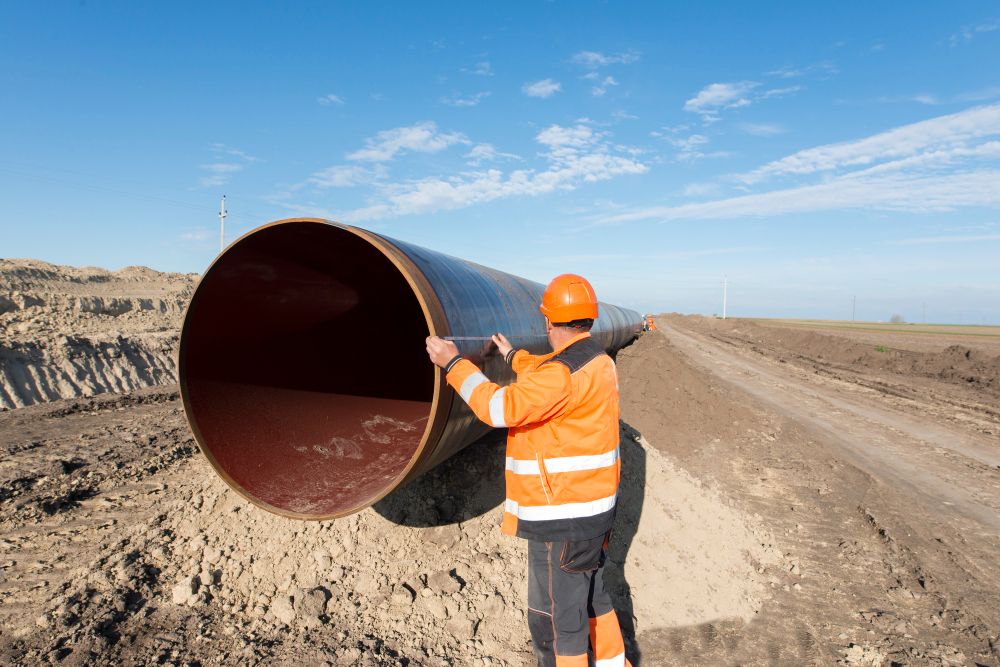
Image Source: Magnific
Long-term contracts and high switching costs make midstream more like a utility than a commodity business in the oil and gas industry.
The financial stability of midstream companies derives from a combination of contractual structure, physical barriers to entry, and the inelastic nature of energy flows. Most pipeline and processing contracts are structured as "take-or-pay" agreements: the customer commits to pay a minimum fee whether or not the contracted volume actually moves through the system. This means the pipeline operator earns revenue even when a producer temporarily curtails output due to low commodity prices.
Replicating pipeline capacity is extraordinarily difficult. Beyond the capital intensity of laying steel pipe across hundreds of miles, new pipeline projects require federal and state permits, environmental reviews, and right-of-way agreements with potentially thousands of landowners. The permitting process alone can take years, and there is no guarantee of approval. Customers who have access to a well-positioned pipeline today are unlikely to find an alternative any time soon, creating switching costs that are often effectively permanent.
Volumes also tend to grow even when commodity prices fall. Producers, particularly those in the Permian Basin and other shale plays, often continue drilling and producing below the breakeven price for individual wells because stopping production carries its own costs and operational complications. The pipeline keeps moving oil regardless.
This combination of contractual certainty, physical irreplaceability, and volume resilience is why midstream assets are routinely compared to regulated utilities. They do not generate the explosive upside of an oil discovery or a commodity price spike, but they produce consistent, predictable cash flows across business cycles, which explains their enduring appeal as income holdings in retirement and institutional portfolios.
What Are the Risks of Midstream Investing?
Despite its utility-like characteristics, midstream is not without meaningful risk. Understanding those risks is essential to evaluating the sector honestly. Midstream is not risk-free.
Regulatory risk is real and ongoing. Interstate natural gas pipelines are subject to rate regulation by the Federal Energy Regulatory Commission (FERC), and FERC decisions on allowed returns or tariff structures can affect revenue meaningfully. State-level regulators can impose additional requirements on gathering and processing assets, and the regulatory posture of federal agencies can shift significantly across administrations.
Counterparty risk became tangible during the 2020 energy downturn, when a wave of exploration and production company bankruptcies left some pipeline contracts contested or unpaid. The quality of the customer base matters enormously. Contracts backed by investment-grade producers carry materially less risk than those supported by highly leveraged, sub-investment-grade operators.
Energy transition pressure is a longer-dated but genuine risk, particularly for natural gas infrastructure. In some regions of the country, especially in the Northeast, assumptions about long-term gas demand face scrutiny as electrification of heating and transportation accelerates. LNG export growth provides a powerful counter-narrative at the global level, but individual assets in demand-constrained geographies may face volume erosion over time.
Permitting difficulty cuts both ways. While it protects incumbents from new competition, it also means that midstream companies cannot always build the capacity needed to capture growth. High-profile project cancellations, including the Constitution Pipeline and the Atlantic Coast Pipeline, demonstrated that even well-capitalized developers with signed customer commitments can be stopped by sustained legal and political opposition.
Concentrated geographic exposure is a further consideration. Companies heavily dependent on a single production basin face amplified downside if that basin's output declines, whether due to geology, prices, or operator capital allocation shifts.
How Do Investors Evaluate Midstream Companies?
Distributable cash flow, contract structure, and counterparty quality matter more than headline yield. Distributable cash flow (DCF) per unit or share, which measures the actual cash the business generates that could be paid to investors after sustaining the asset base.
The contract mix deserves close examination. A company with 90% or more of its revenue coming from fee-based, take-or-pay arrangements is fundamentally different from one with meaningful commodity price exposure embedded in processing or marketing contracts. Investors should understand exactly what proportion of revenue is truly insulated from hydrocarbon price moves.
Counterparty credit quality is equally important. An investment-grade producer like ExxonMobil or Chevron sitting behind a long-term contract offers a very different risk profile than a leveraged private equity-backed driller in an early-stage basin. During the 2020 downturn, the distinction proved significant.
The growth backlog, the pipeline of approved projects under construction or in advanced development, provides visibility into future cash flow growth. Enterprise Products Partners, for example, currently has $4.8 billion of projects under construction. A robust backlog reduces dependence on commodity cycles for earnings growth.
Finally, yield should be assessed in context. Midstream yields often appear high in absolute terms, but an extremely elevated yield can signal balance sheet stress, a deteriorating business, or a distribution that may not be sustainable. Investors should compare the yield against coverage ratios and debt metrics rather than treating it as a standalone attraction.
Why Is Midstream Still a "Rockefeller Moat" in 2026?
Image Source: Magnific
The structural logic of “control the path, capture the toll” has not changed in 150 years. The parallels between Rockefeller's transportation strategy and today's midstream sector are not merely rhetorical. The physical infrastructure connecting supply to demand generates persistent pricing power when it is difficult to replicate and when customers have no practical alternative.
Even as energy mixes shift and the conversation around decarbonization intensifies, hydrocarbons still need to move physically from production to consumption. The United States produced record volumes of oil and natural gas in 2024, and export infrastructure has become a critical growth frontier.
LNG export terminals represent the new pipeline, the physical chokepoints through which U.S. natural gas reaches global markets in Europe and Asia, where demand for cleaner-burning fuel is structurally growing. Companies that own the gathering systems feeding those export docks, the pipelines connecting them to Appalachian or Permian supply, and the terminals themselves hold a position closely analogous to Rockefeller's control of crude pipeline access in the 1880s.
The rapid consolidation now reshaping the sector reinforces this dynamic. As ONEOK's absorption of Magellan and EnLink demonstrates, the largest players are deliberately assembling multi-commodity, multi-basin platforms that are too large and too embedded to be easily bypassed. Permitting difficulty further entrenches incumbents: since no one can easily build a competing pipeline from the Permian Basin to the Gulf Coast, the operators who already own that capacity retain their toll-collecting advantage indefinitely.
Data center power demand is adding a new chapter to this story. Natural gas, transported and stored by the same midstream networks, is increasingly the fuel of choice for the baseload power generation supporting artificial intelligence infrastructure.
Midstream operators with exposure to gas markets serving major data center clusters are capturing a demand tailwind that aligns with broader Automation in Oil and Gas, where digital systems, AI-driven operations, and predictive analytics are optimizing energy infrastructure efficiency and demand response. This convergence of energy infrastructure and Automation in Oil and Gas is reshaping how midstream assets generate long-term value.
The moat is structural, physical, and persistent. Control the path. Capture the toll. The logic endures.
Conclusion
Midstream infrastructure represents one of the most durable competitive advantages in the U.S. economy. Pipelines, storage terminals, processing plants, and LNG export facilities are extraordinarily expensive to build, nearly impossible to permit from scratch, and deeply embedded in the commercial relationships of producers and refiners who depend on them every day. The companies that own these networks and their peers earn fee-based cash flows that are largely insulated from commodity volatility, backed by long-term take-or-pay contracts with creditworthy counterparties.
The Rockefeller parallel is instructive not as historical nostalgia but as structural analysis. When access to a physical path is indispensable, and supply is constrained, the owner of that path earns a toll in perpetuity. That is precisely the position occupied by leading midstream operators today. The assets may be made of steel rather than Standard Oil trust certificates, but the economic logic is identical: control the movement of hydrocarbons, and you control a meaningful share of the value they create.
FAQs
What is midstream infrastructure?
Midstream infrastructure refers to the pipelines, storage terminals, gas processing plants, fractionators, and LNG export facilities that transport hydrocarbons from production sites to refineries, utilities, and export markets. It occupies the segment of the oil and gas value chain between upstream production and downstream refining or consumer distribution.
Why is midstream considered a competitive moat?
Midstream assets are expensive to build, difficult to permit, and deeply embedded in long-term customer relationships. Once a pipeline is in place and contracted, it is extremely hard for a competitor to displace it. This creates persistent pricing power a "toll road" dynamic, that is largely independent of commodity prices.
How does midstream compare to upstream and downstream investing?
Upstream investing offers the highest leverage to commodity prices but also the greatest volatility. Downstream is more dependent on refining margins, which can compress sharply. Midstream, by contrast, earns fee-based revenue from contracted volumes and is far more insulated from price swings, making it more analogous to regulated infrastructure or utilities.
What is a take-or-pay contract?
A take-or-pay contract requires a customer to pay a minimum fee to a pipeline or processing company regardless of whether they actually ship the contracted volume. This structure shifts volume risk from the operator to the producer, ensuring revenue even during production slowdowns or commodity downturns.
Is midstream a good investment for income?
Midstream companies and MLPs have historically offered above-average distribution yields supported by stable, fee-based cash flows. Investors should assess distributable cash flow coverage ratios, debt levels, and contract quality before relying on yield alone. Very high yields can indicate financial stress or an unsustainable distribution.
What are the biggest risks in midstream investing?
Key risks include regulatory changes to pipeline tariff rates, E&P counterparty bankruptcies that put contract payments at risk, long-term demand uncertainty for natural gas in certain regions, permitting challenges that can block new growth projects, and concentrated exposure to single production basins.

Comments